
How an AI Resume Tailor Can Land You More Job Interviews in 2026

Meta Description: Learn how an AI resume tailor can dramatically increase your interview callback rates in 2026 by beating ATS filters, saving hours of work, and making your resume speak directly to every job description.
--
How an AI Resume Tailor Can Land You More Job Interviews in 2026
Let's be honest about something. You've spent hours crafting what you think is a solid resume. You send it out to 20, maybe 30 companies. And then... silence. The occasional auto-rejection email. Maybe one callback if you're lucky. Sound familiar?
Here's the thing: it's probably not your experience that's failing you. It's your resume's inability to speak the right language for each specific job. That's exactly where an AI resume tailor changes the game entirely.
In 2026, the gap between candidates who use AI-powered resume tailoring and those who still rely on a single generic document is massive. We're talking about a 5 to 10 times higher recruiter response rate for tailored resumes versus one-size-fits-all versions. That's not a small edge. That's the difference between getting interviews and getting ignored.
This post breaks down how AI resume tailoring actually works, why it matters more than ever right now, and how to use it without turning your resume into a keyword-stuffed mess.
Why Your Generic Resume Is Getting Auto-Rejected Before a Human Reads It
Most job seekers still don't fully grasp what happens to their resume the moment they hit "apply." It doesn't go straight to a recruiter. It goes into an Applicant Tracking System, or ATS, which is essentially a software filter that scans your document for keywords, phrases, and formatting signals that match the job description.
If your resume doesn't hit a certain match threshold, a human may never lay eyes on it at all.
This isn't a niche problem. Most mid-sized and large companies run their entire applicant pipeline through ATS software. The system is looking for hard skills, specific tools, certifications, industry terms, and even the way you phrase action verbs. A resume that says "managed client relationships" might get filtered out when the job description specifically says "account management" or "CRM oversight."
The ATS doesn't know you mean the same thing. It just scores the match and moves on.
On top of keyword issues, formatting creates its own set of traps. Multi-column layouts, graphics-heavy templates, tables, images, and fancy fonts all cause parsing errors. The system scrambles the text and your resume becomes unreadable to the algorithm. Around 53% of hiring managers prefer text-based PDFs with no images, and about 43% prefer standard Word documents. Anything more decorative than that starts working against you.
What an AI Resume Tailor Actually Does (And How It's Different From a Resume Builder)
A resume builder helps you construct a static document. You fill in your work history, choose a template, export it, and you're done. Same resume. Every application.
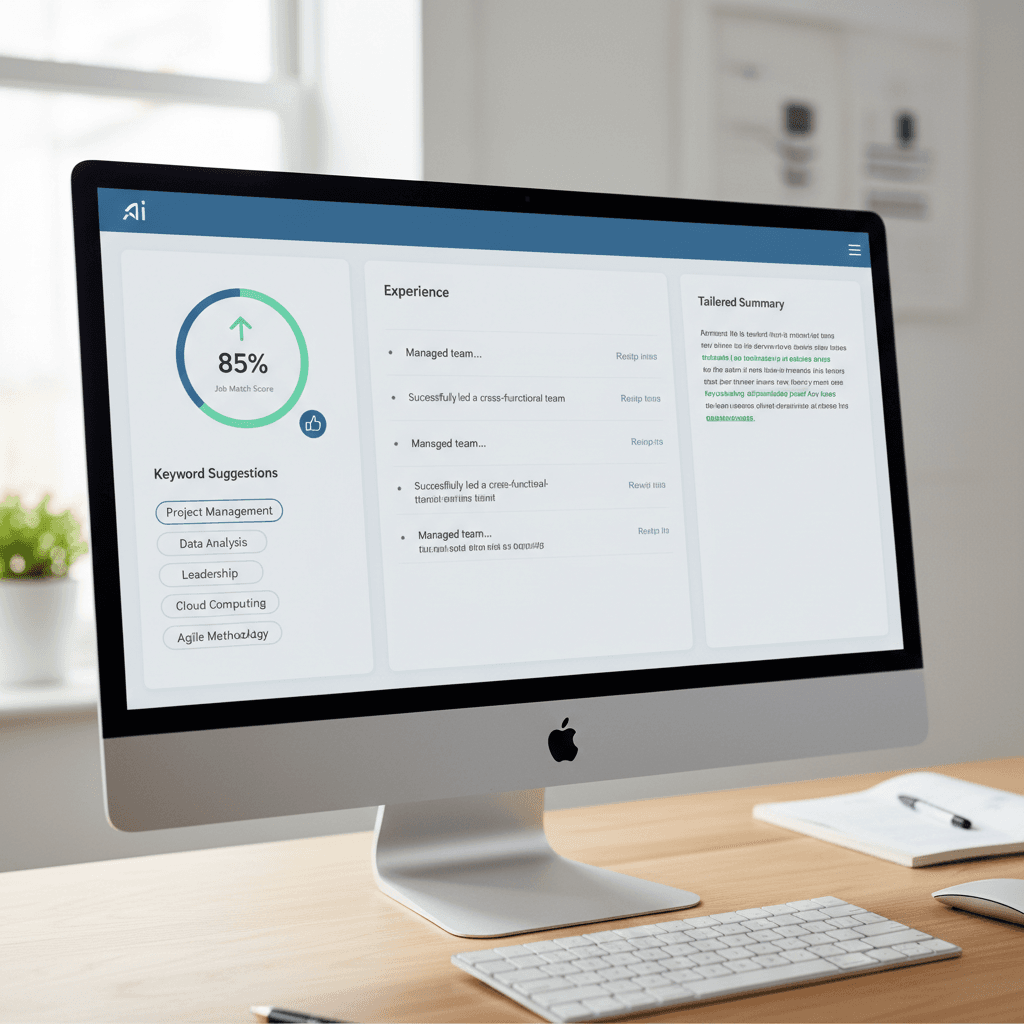
An AI resume tailor works completely differently. You give it two things: your base resume and the job description you're applying for. The tool then analyzes the job description to extract critical skills, tools, certifications, and keywords. It maps those against your experience. Then it rewrites your summary, skills section, and bullet points to foreground the most relevant information for that specific role, while keeping everything factually accurate.
The output is a version of your resume that's been reshaped to speak directly to what that employer is looking for.
Here's a simplified version of how the workflow typically runs:
- Paste in the job description
- The tool extracts priority keywords, required skills, and key role responsibilities
- Your existing bullets and summary get rewritten to surface relevant experience using those keywords
- The tool scores your resume against the job description, often aiming for 75% or higher on an ATS match score
- You review, tweak where needed, and export as an ATS-safe PDF or .docx
That 75% threshold matters. Resumes that hit that score tend to land in the top tier of applicants surfaced to real recruiters. Below that, you're competing in a much noisier pool, or you're not making it through at all.
The Time Math Alone Makes This Worth Using
Manual resume tailoring, done properly, takes 30 to 60 minutes per application. You need to read the job description, identify what they're prioritizing, rephrase your bullet points, adjust your summary, reorder your skills section, and then double-check the formatting. For one job? Fine. For twenty jobs? That's up to 20 hours of writing work, and most of it is repetitive cognitive labor.
AI resume tailors compress that entire process to a few minutes per application. Some tools handle it in under 60 seconds for the initial draft.
For active job seekers applying to dozens of roles at once, this isn't just a convenience. It's what makes high-volume, high-quality applications actually possible. Without AI assistance, you're forced to choose between quantity and quality. With it, you can have both.
Think about what that means practically. Instead of sending out 10 mediocre generic resumes, you can send out 50 well-targeted ones. Even if your response rate stays the same percentage-wise, the raw number of callbacks goes up. And when combined with the documented 5 to 10x improvement in response rates that tailored resumes generate, the math gets very compelling.
How the Best Tools Go Beyond Keyword Matching
Early resume optimization tools were pretty blunt instruments. They'd scan the job description, identify missing keywords, and tell you to add them. That approach worked, sort of, but it also produced some awkward, stilted writing. Resumes that felt like they were written by someone who had read a job listing 40 times and couldn't stop repeating the same phrases.
The better tools in 2026 have moved well past that.
Tools like Huntr use semantic matching, meaning they understand the meaning and context of what you've done, not just whether the exact words appear in both documents. If you managed a team of customer support agents and the job description asks for "team leadership in client-facing roles," a semantically aware system recognizes the connection without requiring identical phrasing.
Reztune focuses specifically on ATS optimization and job description matching, offering what it calls a "tailoring agent" that iterates on your resume until your match score hits the target range. ResumeHog handles one-click ATS-compliant formatting, automatically converting your resume to single-column, standard-header formats with clean fonts. Platforms like Four-Leaf specifically emphasize the per-job tailoring workflow and clean output formatting.
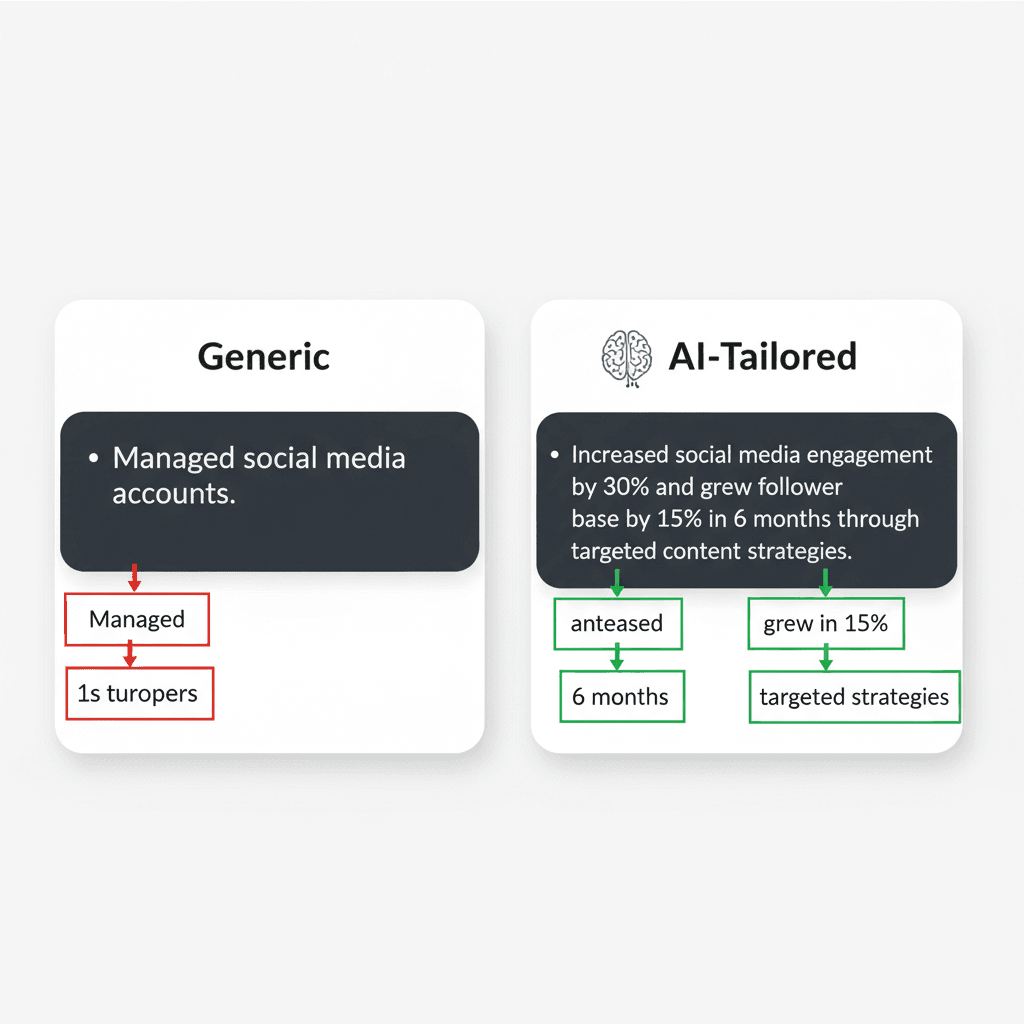
The best tools also follow smart bullet point patterns. Something like: action verb + what you built or did + scale or scope + measurable result. So instead of "Responsible for social media," you'd get "Grew brand Instagram account from 4,000 to 22,000 followers in eight months by implementing weekly content testing cycles." That's a sentence a recruiter actually wants to read.
What About Honesty? The AI Accuracy Question
This comes up constantly, and it's a fair concern. If an AI is rewriting your resume, how do you know it's not making things up?
Quality AI resume tailors are designed with a clear principle: rewrite and reorder, don't invent. The tool works with what you've given it. It rephrases your bullet points to foreground relevant skills, changes the order of information, adjusts terminology to match the job description, and suggests where adding metrics would strengthen a point. It doesn't create experiences you didn't have.
That said, the responsibility for accuracy stays with you. If the tool generates a bullet that overstates your contribution or implies a skill you don't actually have, you need to catch that and correct it before submitting. AI tailoring is a drafting and optimization layer, not a fact-checking service.
One thing worth watching: skills inflation. Some tools will suggest phrasing that sounds impressive but edges past what you actually did. That can backfire badly in interviews when you can't back it up. Review every bullet point the AI generates. If something feels like it overstates your role, pull it back.

AI Literacy on Your Resume Is Now a Signal Itself
Here's an interesting shift happening in 2026. Employers across industries, not just tech, increasingly want to see that candidates are comfortable using AI tools. Being able to say you used generative AI to improve workflow efficiency, analyze data faster, or streamline reporting is now a positive signal on a resume, even for roles in marketing, HR, finance, or operations.
AI resume tailors often surface this kind of experience during the tailoring process. If you've used AI tools in your work and it's buried somewhere in your job history, a good tailoring tool will recognize when to bring it forward based on what the job description is asking for.
The meta-point here is interesting: using an AI resume tailor well is itself a demonstration of digital fluency. Employers want people who can figure out which tools make them more effective and actually use them. Showing up with a perfectly optimized, ATS-matched resume is, in a subtle way, evidence of exactly that.
Formatting Details That Most People Get Wrong
Even if your content is perfect, poor formatting will sink you with an ATS. Here are the most common formatting mistakes that cause parsing failures:
- Multi-column layouts (the ATS reads columns out of order or merges them)
- Text boxes and graphics (often completely invisible to the parser)
- Tables used for skills sections (frequently jumbled or skipped)
- Headers and footers containing contact information (sometimes not parsed at all)
- Creative section titles like "Where I've Been" instead of "Experience"
Standard headings like "Experience," "Education," and "Skills" are what ATS systems are trained to find. Anything creative in that department is a risk.
AI resume tailors now handle a lot of this automatically. Many tools auto-convert your resume into ATS-safe formats on export, stripping out problematic elements and outputting a clean single-column document with standard headings. That alone removes a category of failure that has nothing to do with your qualifications.
How Many Resume Versions Should You Actually Have?
The practical answer most career experts land on: one strong master resume that captures everything you've done, and then one unique tailored version for each application you submit.
The master resume isn't what you send to employers. It's your source document. It captures the full picture: every role, every achievement, every tool you've used, every measurable result you can remember. It's long, probably too long to send, but comprehensive.
The AI resume tailor draws from that master document (or your most recent resume) and creates a leaner, targeted version shaped around each specific job description. Different roles will pull different things to the front. A marketing-focused position will emphasize campaign results and content metrics. A project management role will surface delivery timelines and cross-team coordination. Same background, different emphasis.
For high-volume job searches, candidates are running dozens of tailored variants through these tools. Doing that manually would be a full-time job in itself.
Picking the Right Tool for Your Situation
The tool you choose matters, but not as much as your workflow. Here's a simple way to think about it:
If you're applying across multiple industries or switching careers, look for tools with semantic matching capabilities that understand context, not just keywords. Huntr is a strong option here.
If you're in a specialized field like healthcare, finance, or government contracting, look for platforms with industry-specific models that understand domain jargon. Generic tools sometimes stumble on niche terminology like "FedRAMP compliance" or "GMP protocols."
If your biggest challenge is ATS formatting compliance, ResumeHog's one-click formatting output removes a lot of the manual cleanup work.
And if you want a more comprehensive comparison before committing to one platform, resumetailorguru.com offers a focused look at AI resume tailor options with a clear breakdown of what each tool does well.
Most tools offer a free tier or trial. The smart move is to run one or two real applications through a tool before deciding whether to pay for it. Judge it by actual results: does the tailored output read naturally? Does it accurately represent your experience? Does the ATS score improve meaningfully?
Putting It Together: A Realistic Job Search Approach for 2026
The job market hasn't gotten easier. Application volumes are up, ATS filters are more aggressive, and recruiter attention is a genuinely scarce resource. A generic resume in this environment is just noise.
The good news is that the tools available now make it genuinely feasible to apply strategically at scale. One strong master resume. A reliable AI resume tailor. A target ATS match score of 75% or above before you submit. Clean formatting that the system can actually read. Honest, metric-driven bullets that tell a recruiter what you actually accomplished.
That combination is what moves you from the rejection pile into the callback column. It's not magic. It's just a smarter approach to a process that most people still treat as a copy-paste job.
If you haven't tried an AI resume tailor yet, the time to start is now. Your next interview might already be one well-tailored resume away.